Left on the Shelf: What the Souvenirs You Walked Away From Say About the Traveler You've Become
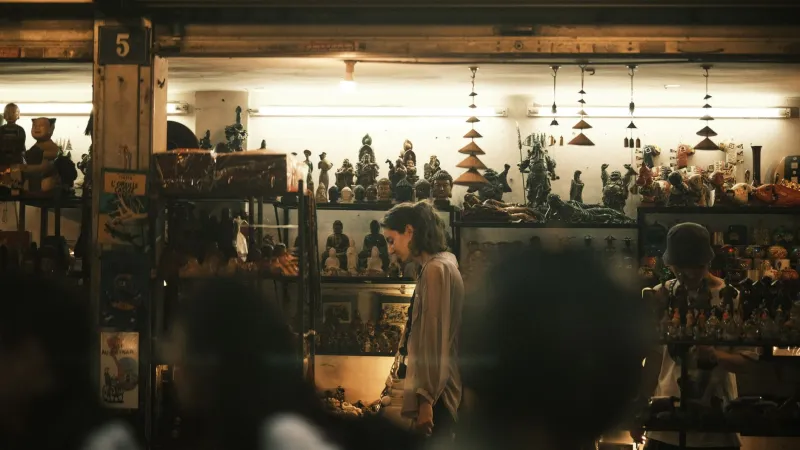
There's a particular version of yourself that shows up in souvenir shops. She picks things up. She turns them over. She reads the sticker on the bottom, does a quick mental calculation involving checked baggage fees and the empty corner of her living room, and then — more often than not these days — she sets it back down.
You probably know this version of yourself pretty well by now.
The object in question doesn't matter much. It could be a hand-painted ceramic bowl in Santa Fe, a leather-bound journal in a Florence side street shop, or one of those aggressively specific snow globes that somehow makes every major American city look exactly the same. What matters is the pause. The hesitation. The moment where you genuinely considered it and then decided, with full awareness, to walk away empty-handed.
That moment? It might be the most honest souvenir you'll ever collect.
The Old Way We Used to Shop Our Travels
For a lot of us who grew up in families that traveled — even just road trips to national parks or beach weeks in the Outer Banks — the souvenir was non-negotiable. You went somewhere, you brought something back. A magnet for the fridge. A shot glass for the cabinet nobody really uses. A t-shirt that would survive exactly four washes before becoming a paint shirt.
The logic was straightforward: the object proved the trip happened. It was physical evidence of an experience, something you could point to and say I was there.
But somewhere along the way, for many travelers, that calculus quietly shifted. The evidence started feeling less necessary. The trips themselves — the memories, the photos, the stories you tell at dinner parties — became the proof. And suddenly the shops that once felt like a required stop on every itinerary started feeling more like a test.
A test of who you are now versus who you used to be.
What Your Hesitation Is Actually Telling You
Here's the thing about almost buying something: it's not nothing. The fact that you picked it up at all means something caught your attention. Something in that object resonated with whatever version of yourself you were in that moment, in that place.
Maybe it was a small painting at a street market in New Orleans — bold colors, loose brushwork, clearly made by someone with something to say. You held it for a full two minutes. You even asked the artist about it. And then you thought about your apartment walls, already full, and your suitcase, already heavy, and you set it down and kept walking.
But you didn't forget it. You're thinking about it right now, aren't you?
Psychologists who study consumer behavior have a name for the strange grief that can follow a purchase we don't make — it's sometimes called anticipated regret, and travelers are particularly susceptible to it because we know, rationally, that we can't go back. The market closes. The trip ends. The painting sells to someone else.
But here's what that research doesn't quite capture: sometimes the thing you feel walking away isn't regret at all. Sometimes it's relief. A kind of lightness. The satisfaction of knowing yourself well enough to recognize that the object, however beautiful, was never really going to be yours.
That's not loss. That's clarity.
The Stories We Build Around Things We Leave Behind
Ask any well-traveled person about the best thing they ever didn't buy, and watch what happens. Their face changes. They get specific. They remember the exact shop, the approximate price, the way the light was falling.
The unpurchased souvenir has a strange staying power that a lot of purchased ones don't. Your kitchen drawer probably has a corkscrew from somewhere you can no longer quite place. But the hand-knotted rug you spent forty-five minutes negotiating over in a Marrakech medina before finally walking away — that one you remember in full detail, complete with the vendor's expression when you left and the way you second-guessed yourself for the rest of the afternoon.
We construct narratives around these near-misses. We cast ourselves as characters in them. The disciplined minimalist. The reluctant romantic who almost let themselves have something beautiful. The practical adult who chose the overhead bin space over the impulse.
And sometimes, honestly, the story we tell about why we didn't buy the thing is more revealing than the thing itself ever could have been.
When Restraint Becomes Its Own Kind of Collecting
There's a certain type of traveler — and maybe you're becoming one — who has quietly replaced the act of acquiring with the act of noticing. Who moves through markets and shops with genuine curiosity but without the old compulsion to convert every experience into an object.
This isn't minimalism for minimalism's sake, and it's definitely not about moral superiority over anyone who loads up a checked bag with locally made goods. It's more personal than that. It's the recognition that your relationship with stuff has evolved, and that travel, of all things, has been the teacher.
The first few trips you take, you want to hold onto everything. You buy the magnet, the postcard, the locally made hot sauce you'll use exactly once. You're trying to keep the trip from ending. You're trying to make it real in a way that will survive re-entry into your regular life.
But somewhere around your tenth or fifteenth trip — or maybe your third, if you're paying close attention — you start to realize the trip is already real. It's happening in you, not in the objects around you. And the most interesting question shifts from what should I bring home? to what am I actually responding to here, and why?
The Shelf You Leave Them On Is Part of the Story
There's something worth sitting with here, and it's this: the objects you leave behind in shops around the world don't disappear from your story. They become part of it in a different way.
The ceramic bowl stays on the shelf in that little shop in Taos. Someone else buys it, takes it home to Denver or Austin or wherever, puts it on their kitchen counter. It goes on living its life without you. And you go on living yours, carrying nothing but the memory of the weight of it in your hands and the color of it in the afternoon light.
That's not nothing. That might actually be everything.
The most honest measure of how travel has changed you isn't what you bring home. It's what you're capable of leaving behind — and how clearly you can see yourself in the moment you make that choice.
Put it down. Walk away. Remember it forever. That's a souvenir no luggage tag can hold.