What You Said No To: How Your Rejected Souvenirs Reveal the Traveler You're Quietly Becoming
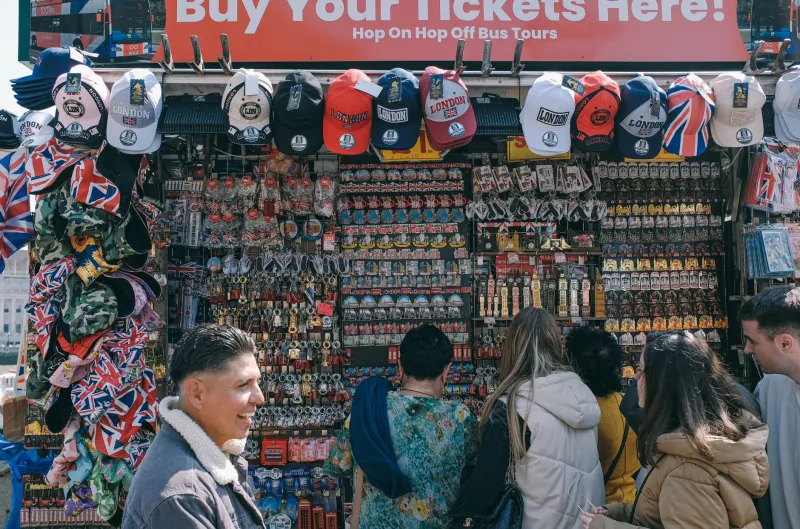
Every traveler talks about what they brought home — the pottery, the scarves, the refrigerator magnets lined up like tiny confessions. But the stuff you deliberately walked past? That's the real autobiography. Your 'nos' on the road are doing more character work than you probably realize.
There's a particular moment that happens in almost every market, every gift shop, every seaside stall from Savannah to Santorini. You pick something up, you feel the weight of it in your hand — literally and figuratively — and then you put it back down. You walk away. And somehow, that small act of walking away carries more meaning than a carry-on stuffed to the zipper.
This is a piece about those moments.
The Object You Kept Touching But Never Bought
You know the one. Maybe it was a hand-painted ceramic bowl at a weekend market in New Mexico. Maybe it was a leather-bound journal at a tiny shop in a neighborhood you stumbled into by accident. You picked it up twice, maybe three times. You imagined it on your kitchen counter. You almost did it.
And then you didn't.
Psychologists who study consumer behavior have a term for the emotional weight of unchosen objects — they call it anticipated regret, the feeling you project onto a future version of yourself who didn't buy the thing. But here's what's interesting: most of the time, that regret never actually shows up. You get home, you unpack, and the bowl you didn't buy simply... doesn't exist in your memory the way you feared it would.
What does linger is the moment of decision. The pause. The putting it back.
That pause is a story.
Restraint as a Form of Self-Knowledge
There's a version of travel that's essentially competitive accumulation — more stamps, more landmarks, more stuff. American travel culture, especially, has historically leaned into the souvenir as proof of presence. You were there. Here is the thing to prove it.
But something shifts in the traveler who has done this enough times. At some point — and it's different for everyone — the objects stop feeling like evidence and start feeling like obligation. The magnet on the fridge that you can no longer remember buying. The woven bracelet you wore twice. The shot glass that lives in a drawer.
When you stop buying those things, it's not minimalism for minimalism's sake. It's something quieter and more specific. It's the recognition that you've changed your definition of what it means to take something home.
The 'no' you say to the tchotchke is actually a 'yes' to something else — to the memory of the afternoon you spent in that market without loading yourself down. To the conversation you had with the vendor even though you didn't buy anything. To the lightness of walking out empty-handed and feeling, somehow, fuller.
The Experiences You Chose Not to Chase
It's not just objects, either. The rejection narrative extends to experiences — the tour you skipped, the popular restaurant you opted out of, the sunrise hike you slept through on purpose.
Travel in the social media era has created this intense pressure to optimize every hour, to collect experiences the way previous generations collected snow globes. The FOMO is real and it's loud. But the traveler who's been at this long enough starts developing a different instinct: the ability to look at something everyone else is doing and genuinely, peacefully say, "That's not for me right now."
That's harder than it sounds. Opting out of the 'must-do' requires a certain confidence in your own version of the trip — a willingness to let your story diverge from the consensus itinerary.
And those divergences? They're almost always where the best chapters happen.
The Shelf You Left Everything On
Think back to the last trip where you exercised real restraint — where you walked through a market or a gallery or a shop and came out with nothing but the experience of having been there.
What do you remember about it?
My guess is you remember more than you think. The colors of the textiles you touched but didn't buy. The smell of the place. The moment you almost caved on something ridiculous and then laughed at yourself. The way the afternoon light hit the shelves.
Objects, ironically, can crowd out memory. When you're focused on acquiring, you're in a transactional mode — evaluating, calculating, deciding. When you're not buying anything, you're just... present. You're actually inside the experience rather than shopping it.
The shelf you left everything on becomes, in retrospect, one of the most vivid scenes in your travel memory. Because you were paying attention instead of paying.
What Your 'No' Says About Chapter Two
There's a reason this site is called Chapter Two. Not Chapter One — that's the version of the trip where you're still figuring out who you are as a traveler, still accumulating the props and the proofs, still building the identity out of external things.
Chapter Two is when the identity is already there. It doesn't need props. It travels lighter, literally and metaphorically. It knows which markets are worth lingering in and which are worth walking through without opening your wallet. It has learned, through enough 'yeses' in earlier chapters, exactly when to say no.
The souvenirs you didn't buy are, in that sense, the most honest record of your evolution. They mark the moments when you trusted your own narrative over the one being sold to you — sometimes literally — from a stall in a tourist market.
That's not cynicism. It's clarity.
Rewriting the Souvenir Story
None of this is an argument against buying things when you travel. A beautiful, intentional object that you've chosen carefully and carried home with care can be one of the most meaningful things in your house. The difference is in the intention — the object chosen because it genuinely means something versus the object grabbed because it felt like the thing to do.
The real shift happens when you start treating your 'nos' with the same respect as your 'yeses.' When you recognize that the story of what you walked away from is just as worth telling as the story of what you brought home.
Because here's the truth: nobody ever frames a photograph of the thing they didn't buy. But they remember the moment they put it back on the shelf with a clarity that surprises them, sometimes years later.
That clarity? That's the souvenir. And it didn't cost you a thing.