Put the Phone Down: What Happens When You Let a Moment Exist Only for You
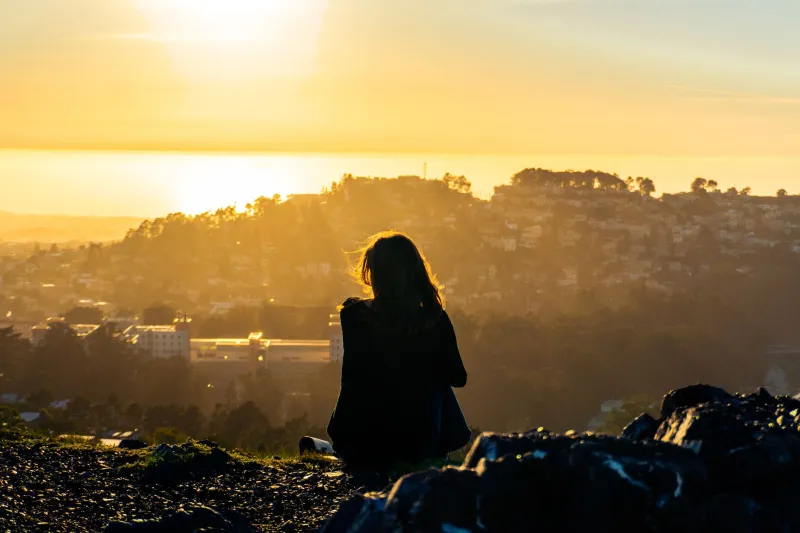
You know the one. That moment where your hand instinctively reached for your phone — and then didn't. Maybe something stopped you. The light was too perfect and you knew the camera would flatten it. Maybe you were laughing too hard to fumble for the lens. Maybe, just once, some quieter instinct whispered: this one's mine.
That moment? It's probably still with you.
Which is kind of wild, when you think about it. We spend entire trips engineering photographs — chasing golden hour, waiting for crowds to clear, contorting ourselves at overlooks for a clean shot. And then the thing we remember most vividly when we're back home, sitting in traffic on the I-95 or zoning out in a Monday morning meeting, is the thing we never captured at all.
The Camera as Distance
There's a study that floats around in psychology circles — researchers found that photographing objects actually reduces how well people remember them. The act of outsourcing memory to a device seems to signal to your brain: someone else is handling this. So it loosens its grip. Moves on.
That's not a judgment on photography. Travel photography is a genuine art form, and some people use a camera to look more closely at the world, not less. But there's a version of documenting a trip that functions more like a nervous habit than creative expression — the reflexive grab for the phone the second anything beautiful happens, the faint anxiety when you realize you didn't get a shot of the thing you just experienced.
That version creates a strange paradox: you were there, technically. But were you?
What Makes a Moment Feel Too Big to Frame
Ask most travelers about their unphotographed memories and they'll often describe the same categories.
There's the overwhelm moment — standing somewhere so vast or so quietly extraordinary that pulling out a phone feels almost rude. The first time you see the Grand Canyon in person, or round a bend in coastal Maine and hit a view that stops you mid-step. Something in you knows the camera can't hold it. So you just... stand there. And your whole nervous system takes it in instead.
There's the human moment — a stranger who helped you when you were genuinely lost, not Instagram-lost but actually-couldn't-find-your-hotel lost. The elderly man in New Orleans who walked you three blocks out of his way and told you about the neighborhood as it used to be. You weren't going to photograph him. That felt wrong. So instead you listened, and you still hear his voice sometimes.
And then there's the laughter moment — the ones that happen too fast and too genuinely to perform for a lens. A travel companion doing something absurd. A joke that landed perfectly because of where you were and what had happened that day. Context-dependent joy that could never survive being explained in a caption anyway.
These are the moments that resist the frame. And in resisting it, they go somewhere deeper.
The Invisible Highlight Reel
Here's what's interesting about the unrecorded moments: they don't fade the same way photographs do.
Photographs are static. You look at them and remember the photograph — the composition, whether you liked how you looked, the moment you chose to post it. The actual sensory experience underneath the image gets thinner over time, like a photocopy of a photocopy.
But the moments you held only in your body? They stay weirdly textured. You remember the temperature. The smell. The specific quality of the light that you knew the camera couldn't catch, which is why you didn't try. You remember what you were thinking. You remember how it felt to be exactly that person, in exactly that place, without an audience.
That's not nothing. That might actually be the whole point.
The Performing Traveler vs. The Present One
Social media has introduced a character into travel that didn't really exist before: the performing traveler. Someone who experiences a destination partly — sometimes primarily — through the lens of how it will read to people back home. The caption is drafted before the coffee is finished. The reel is assembled before the flight lands.
This isn't a generational dig. Plenty of older travelers do it too, and plenty of younger ones are actively pushing back on it. But it's worth naming, because it has genuinely changed the internal texture of travel for a lot of people.
When you're performing an experience, you're split. Part of you is present; part of you is already somewhere else, narrating. And the moments that don't fit a narrative — the weird, quiet, confusing, too-personal-to-explain moments — tend to get edited out. Not just from the feed. From your attention, in real time.
Those edited-out moments are often the most honest ones.
A Different Kind of Souvenir
There's a version of travel where you come home with a camera roll full of beautiful images and a vague sense of having missed something. And there's another version where you come home with fewer photographs and a handful of moments that feel like they actually belong to you.
Neither is wrong, exactly. But they're different experiences, and it's worth being intentional about which one you're choosing.
Some travelers have started building small rituals around this — leaving the phone in the bag for the first hour in a new city, or picking one meal per trip to eat without documenting it, or making a deal with themselves that certain kinds of moments are simply off-limits to the camera. Not as a performance of mindfulness. Just as a quiet agreement to let some things stay private.
Because here's the thing about a moment that exists only for you: nobody can like it, share it, or scroll past it. It just sits there in your memory, doing its quiet work. Reminding you, months later on some unremarkable Tuesday, that you were somewhere extraordinary once — and you were actually there.
That's the chapter two of any good trip. The part that doesn't get posted. The part that stays.