What You Picked Up for Someone Else: The Secret Language of Travel Gifts
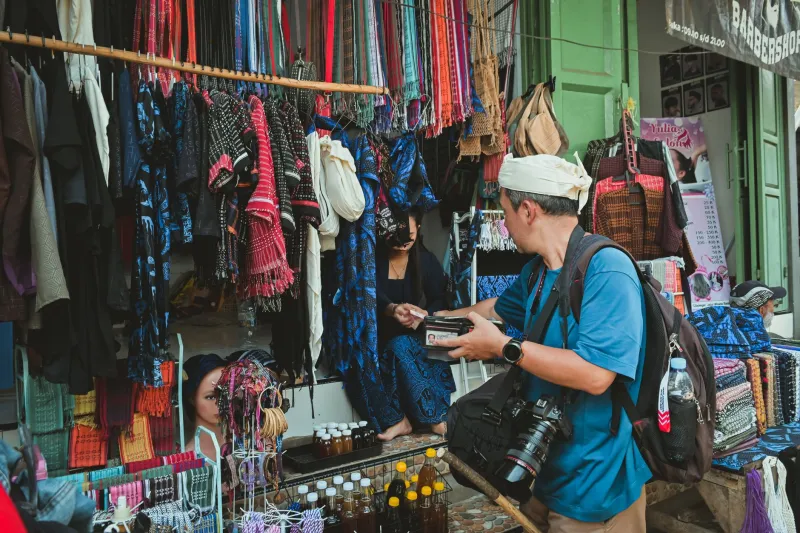
You probably didn't think too hard about it in the moment. You spotted something on a shelf — a small ceramic dish, a hand-dyed scarf, a jar of something local and fragrant — and your brain immediately went: her. Or him. Or your college roommate who would absolutely get this in a way no one else would. You picked it up, wrapped it carefully in a sweater so it wouldn't break, and carried it home like it mattered. Because it did.
Here's what's interesting: the gifts we bring back for other people are almost never really about the objects themselves. They're about something that happened to us while we were away — some quiet recalibration in how we see the world, and more specifically, how we see the people waiting for us back home.
The Moment You Stopped Shopping for Yourself
Every traveler knows that particular shift that happens somewhere in the middle of a trip. You stop being a tourist trying to consume a place and start actually living inside it, even temporarily. And somewhere in that transition, you start noticing things not for yourself but for other people.
You'll be walking through a street market in Morocco or browsing the back shelves of an independent bookshop in Edinburgh, and suddenly you're not thinking about what you want. You're thinking about your sister who's been going through it lately, or your dad who collects obscure things he'd never buy for himself, or your best friend who has somehow never been to Europe and deserves to hold something that came from there.
That mental pivot — from I to them — is one of the quieter gifts travel gives you. It's a kind of generosity that gets unlocked when you're removed from the noise of your everyday life. When you're not distracted by your to-do list or the group chat or whatever's happening on the news, you have actual space to think about the people you love. And it turns out, when you're really paying attention, you know them better than you realized.
What You Actually Know About Someone (That You Forgot You Knew)
There's a theory that we stop truly seeing the people closest to us. Familiarity blurs them. You know your mom, but do you really see her anymore the way a stranger might? Travel has this odd way of sharpening your vision — including your vision of the people you left behind.
Stand in front of a wall of handmade goods in a craft market in Asheville or a textile stall in Chiang Mai, and suddenly you're running through a mental file of your people with startling clarity. You remember that your brother has been quietly obsessed with woodworking for three years. You remember that your college friend once mentioned she collects small spoons from places she's never been. You remember things you didn't know you'd stored.
The act of gift-shopping abroad forces a kind of active listening — retroactive, maybe, but real. You're pulling up details about someone's personality that you absorbed without meaning to, and suddenly those details matter. The gift becomes proof that you were paying attention all along.
The Difference Between a Souvenir and a Statement
Not all travel gifts are created equal, and if you've ever received a generic airport keychain versus something clearly chosen with intention, you already know the difference in your bones.
A thoughtful travel gift is a statement. It says: I was somewhere extraordinary, and I thought of you specifically, not just generally. It says: I saw this thing and it reminded me of something true about you. That's a fundamentally different message than a mug with a city skyline on it, which says: I was away and you crossed my mind long enough for me to grab something.
The specificity of a good travel gift is what makes it land. And specificity requires that the giver actually knows the recipient — not just their surface preferences, but something deeper. Something about what makes them laugh, or what they find beautiful, or what corner of the world they've always wanted to visit but haven't yet.
When you bring someone a gift like that, you're not just giving them an object. You're giving them evidence of your relationship.
How the Giving Changes When You've Been Changed
Here's where it gets interesting: the gifts we choose after meaningful travel are different from the ones we'd choose before. And not just because we've been exposed to more options.
Travel rewires your sense of what's worth having. It recalibrates your taste, your sense of scale, your understanding of what's abundant and what's rare. After you've spent time somewhere that values craft and slowness — say, a week in rural Japan or a few days in a small Peruvian village — you start looking at mass-produced things differently. You start reaching for the handmade, the locally sourced, the thing that took someone actual time to create.
And when you bring that sensibility home as a gift, you're sharing more than an object. You're sharing a new value system. You're saying: I learned something about what matters, and I want you to hold a piece of that.
Some people get it immediately. Others look at the hand-thrown pottery or the small batch olive oil and are a little confused. That gap — between what you hoped to share and what they received — is also data. It tells you something about where you are now versus where you started.
The People Who Changed While You Were Gone
Here's the part nobody really talks about: sometimes you come home and realize the gift you chose no longer quite fits the person you left. Not because you chose wrong, but because they changed too. Life didn't pause while you were away.
Your friend who was obsessed with cooking took a different direction while you were gone. Your sibling moved through something hard and came out different on the other side. The small thing you carried home for them still matters — maybe more than ever — but it lands differently than you expected. And that small moment of recalibration, of updating your mental model of someone you love, is actually one of the most human parts of returning home.
Gifts open that conversation. They create a reason to sit down, catch up, and see each other clearly again.
Bringing a Piece of Yourself Home in Someone Else's Hands
At the end of it, the best travel gifts are never purely about the place you visited. They're about the version of you that walked through that place — curious, open, paying attention in a way daily life rarely allows.
When you hand someone something you carried home for them, you're not just giving them a thing from somewhere far away. You're giving them a small, wrapped-up piece of who you were while you were there. The person who noticed that detail. The person who thought of them in a market on the other side of the world.
That's the gift underneath the gift. And honestly? It's the one that lasts.