Your Eyes Came Home Different: How Travel Quietly Rewrites What You Find Beautiful
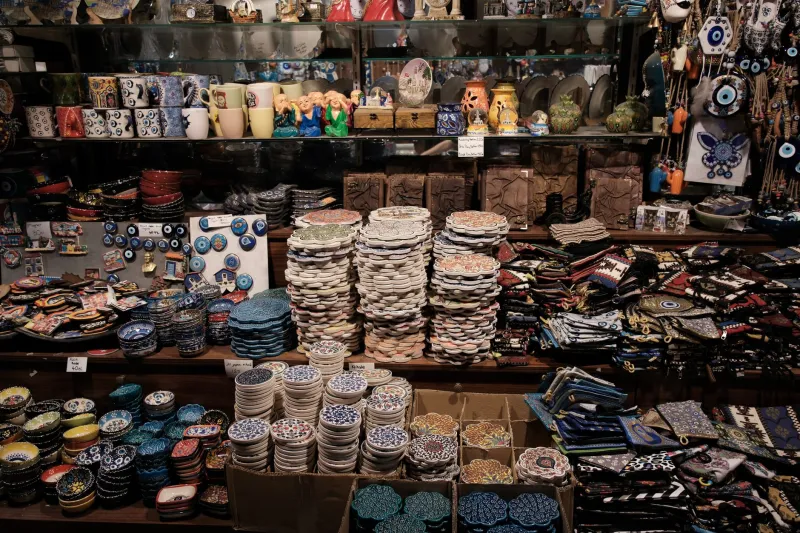
You probably didn't notice it happening. There was no single moment where you sat down and decided that you were done with cool grays and minimalist interiors. But somewhere between a tiled courtyard in Lisbon and a spice market in Marrakech, your visual vocabulary got completely overhauled — and nobody sent you a memo.
That's the sneaky thing about travel and taste. The souvenirs you actually carry home — the magnets, the folded scarves, the snow globes — those are the obvious ones. But the invisible ones? The ones that rewire what your eyes reach for, what your hands want to touch, what colors feel like home now? Those are the keepers. And they cost you nothing except time and attention.
The Palette Shift Nobody Talks About
Most of us grow up inside a pretty narrow color story. The suburban American interior of the last two decades leaned heavily into greige, white shiplap, and the occasional navy blue accent wall. It was safe. It was HGTV-approved. It was fine.
And then you spent three days in a small town in southern Italy where every building was a different shade of ochre, rust, and sun-bleached apricot, and suddenly fine wasn't going to cut it anymore.
This isn't coincidence — it's sensory accumulation. When you're immersed in a place long enough to stop being a tourist and start being a temporary resident, your brain begins cataloging color the way it catalogs language. Passively at first, then with increasing fluency. You stop noticing the colors and start feeling them. The warm amber of a Moroccan lantern at dusk. The washed-out sage of a Greek doorframe. The almost-painful brightness of hand-painted signs in a Vietnamese street market.
By the time you land back at O'Hare or LAX, your internal color library has a whole new wing. And it will quietly start influencing every decision you make.
The Furniture You Suddenly Need to Explain
Ask anyone who's done serious travel, and they'll tell you some version of the same story: they came home and couldn't unsee their own space.
One friend spent two weeks moving through Japan — ryokans, temple gardens, the kind of interiors where every object earns its place — and returned to her Chicago apartment feeling like she was living inside a storage unit. She didn't gut the place. She didn't spend thousands on a redesign. But over the next year, things slowly disappeared. Excess furniture. Decorative clutter that had never actually meant anything. She replaced it with less, but better. A single ceramic bowl on the kitchen counter. A low wooden bench by the door. She couldn't fully articulate the logic, but she knew exactly where the impulse came from.
That's not interior design. That's travel residue.
And it goes beyond furniture. It shows up in what you reach for at the farmers market (you never cared about heirloom tomatoes until you ate them in a Provençal village). It shows up in your wardrobe (linen everything, after that one summer in Portugal). It shows up in the music you stream on Sunday mornings and the candles you light and the way you set a table when people come over.
Design Literacy You Didn't Study For
Here's what's interesting: travel gives you a design education without ever putting you in a classroom. You absorb principles — proportion, texture, the relationship between light and space — by simply existing inside places that have been doing it well for centuries.
Walk through the medinas of Fez and you develop an intuitive understanding of geometric pattern and how repetition creates rhythm rather than monotony. Spend time in Scandinavian cities and you start to understand why restraint is its own kind of luxury. Drift through the neighborhoods of New Orleans and your relationship with ornament, color, and layered history gets permanently complicated in the best possible way.
None of this is formal. Nobody handed you a syllabus. But the education happened anyway, and now you're the person at the houseware store who picks up a bowl and says, "This feels too heavy for what it's trying to be" — and actually knows why.
The Taste You Grow Into
There's a version of aesthetic evolution that happens through Pinterest boards and interior design accounts and carefully curated Instagram feeds. And that's fine — that's how a lot of us build our visual language from the comfort of our couches.
But travel-informed taste has a different texture to it. It has context. It has the memory of a specific afternoon light in a specific place. It carries the slight imperfection of handmade things bought from the person who made them. It's less about trend and more about meaning.
When you bring home a hand-thrown mug from a pottery studio in Asheville or a woven textile from a market in Guatemala City, you're not just acquiring an object. You're anchoring a sensory memory to something physical. And every time you use that mug or glance at that textile, the aesthetic experience of that place gets reactivated. Your taste becomes a kind of personal archive.
This is why the homes of well-traveled people often feel so specific. Not expensive, necessarily. Not decorated by a professional. But intentional in a way that's hard to fake — because it isn't faked. Each thing earned its place through experience.
What Your Home Is Actually Saying
Step back and look at your space right now — really look at it. Not as a to-do list of things to fix or update, but as a document. What does it say about where you've been? What colors have crept in from places you've stood? What textures have you sought out because your hands remember something?
Your home is a quiet autobiography of everywhere that ever changed your eye. The shift toward warmer tones after a winter trip to Santa Fe. The sudden appreciation for raw wood and natural light after a week in the Pacific Northwest. The inexplicable pull toward indigo and hand-block-printed fabric after one afternoon in Jaipur.
Travel doesn't just give you memories. It gives you a new set of eyes — and those eyes don't go back to seeing the way they used to. The world looks different now. Your living room looks different now. Your wardrobe, your table, your sense of what's beautiful and why.
You didn't know you were collecting any of this. But you were. Every single time.